- The project began from concepts studied in Blockchain Accelerator Module 11 and was rebuilt as an original end-to-end product rather than a copied course exercise.
- It expands the educational mechanics into a broader contract API, original contracts, deterministic mocks, optional fork validation, deployment workflows, documentation, and a purpose-built frontend.
DeFi protocol integration
LiquidityPilot
A non-custodial Solidity and Next.js application for exact-input token swaps and one-click Uniswap V2-compatible liquidity management on Arbitrum, including one-sided pool entry, standard LP removal, and single-token exit.
RoleSmart Contract & Frontend Engineer
TimelineJuly 2026
Team1
FocusDeFi protocol integration
Exact approvalsLP lifecycleSimulation first
Overview
A complete V2 liquidity-management integration covering token approvals, swaps, LP custody, one-sided entry, single-token exit, dust refunds, live on-chain state, transaction simulation, and realistic fork testing.
A non-custodial Solidity and Next.js application for exact-input token swaps and one-click Uniswap V2-compatible liquidity management on Arbitrum, including one-sided pool entry, standard LP removal, and single-token exit.
Problem, context, and constraints
Liquidity management is substantially more complex than making a router call: users need defensible minimum outputs and deadlines, while ERC-20 and LP-token allowances must be intentionally scoped.
Liquidity removal only works when the integration contract actually owns the LP tokens it asks the router to spend; an approval alone does not move user-held LP tokens into contract custody.
One-sided entry and single-token exit introduce intermediate assets, multiple router boundaries, and remainder accounting that must be reconciled without sweeping unrelated balances.
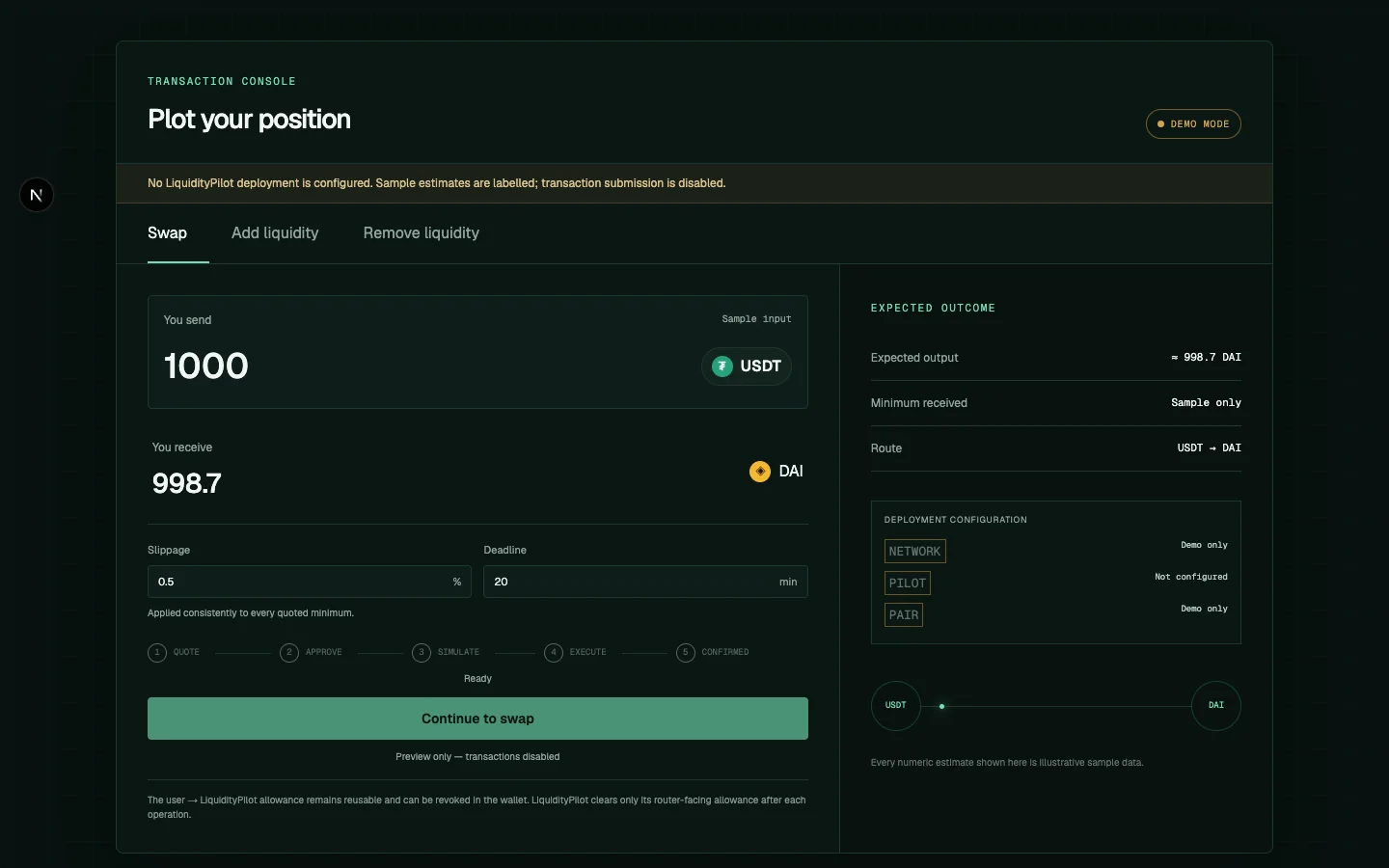
Frontend previews must separate illustrative demo values from live balances, pair composition, reserves, allowances, LP ownership, and quotes.
- LiquidityPilot is educational portfolio software. It is not audited, production-ready, or recommended for real funds.
- No Arbitrum mainnet LiquidityPilot deployment is claimed. The public site intentionally remains in clearly labelled Demo mode until a valid contract address and matching environment are configured.
- Fee-on-transfer and rebasing tokens are not supported; compatible router, factory, pair, and ordinary ERC-20 behavior remain external trust assumptions.
- Minimum outputs and deadlines reduce but do not eliminate MEV, sandwich exposure, adverse price movement, or execution risk.
- The educational 50/50 zap split is predictable but not reserve-optimised.
My role and contribution
Smart Contract & Frontend Engineer
- Designed an immutable router-and-factory-based Solidity coordination contract with no owner, fee collector, proxy, or privileged withdrawal surface.
- Added configurable exact-input swaps, including multi-hop paths.
- Added one-sided direct-pair entry with a single input transfer.
- Minted LP tokens directly to the selected recipient.
- Tracked and refunded unused operation-specific token deltas.
- Implemented correct LP-token custody before liquidity removal.
- Added standard two-token removal and single-token exit.
- Used SafeERC20, exact forceApprove values, post-operation allowance clearing, custom errors, and reentrancy protection.
- Added deterministic unit tests and fuzz properties for accounting and minimum-output boundaries.
- Added optional Arbitrum fork tests covering deployed router and factory bytecode, pair composition, quotes, swaps, liquidity entry, and removal.
- Built a Next.js frontend with React, wagmi, and viem.
- Added wallet and network guards, factory pair discovery, pair-composition validation, live balances, allowances, reserves, LP ownership, and debounced quotes.
- Implemented simulation-first execution, mined-receipt handling, query refreshes, and explicit transaction stages.
- Added separate contract and frontend GitHub Actions workflows.
- Documented architecture, security, learning, deployment, and reproducibility workflows.
Architecture and system details
A wallet connects to a typed Next.js console that validates the configured network, discovers the pair through the factory, and reads live balances, allowances, reserves, LP ownership, and quotes. LiquidityPilot coordinates exact-input swaps, one-sided entry, standard removal, and single-token exit across immutable V2 router and factory boundaries. Operation-delta accounting settles only assets created by the current call, while deterministic mocks, optional Arbitrum fork validation, local Anvil workflows, CI, and an explicit Vercel Demo mode cover delivery and review.
01Wallet and frontend
- Next.js, React, and TypeScript
- wagmi and viem
- Wallet connection and network validation
- Live token balances, LP ownership, reserves, allowances, and quotes
02LiquidityPilot contract
- Immutable V2 router and factory
- Swap, zap-in, remove-liquidity, and single-token-exit flows
- SafeERC20 and exact approvals
- Custom errors and reentrancy protection
03V2 protocol boundary
- Factory pair discovery
- Router quotes and execution
- Pair token composition
- LP-token lifecycle
04Testing and delivery
- Deterministic mocks
- Unit and fuzz tests
- Optional pinned Arbitrum fork validation
- Local Anvil workflows
Key technical decisions
- Context
- The router can only spend LP tokens held by the address that grants it an allowance.
- Choice
- Transfer the exact LP amount from the user into LiquidityPilot before approving the router and beginning removal.
- Tradeoff
- This adds an explicit custody step to the transaction, but avoids the incorrect pattern of approving tokens the contract does not own.
- Context
- Persistent or unlimited router allowances increase exposure to an external integration boundary.
- Choice
- Approve only the required token or LP amount with forceApprove and clear router-facing allowances after the operation.
- Tradeoff
- Extra approval writes cost gas, but reduce the amount and duration of router approval exposure.
- Context
- The coordination contract does not need to retain LP tokens or final swap output after successful execution.
- Choice
- Mint LP tokens and send swap or standard-removal output directly to the selected recipient wherever the router supports it.
- Tradeoff
- This minimises unnecessary custody, while making recipient validation and flow-specific settlement design essential.
- Context
- One-sided entry and single-token exit can leave small intermediate remainders, while unrelated tokens may already have been sent to the contract accidentally.
- Choice
- Snapshot starting balances and refund only balance changes created by the current operation.
- Tradeoff
- Delta accounting adds bookkeeping, but prevents one caller from receiving unrelated pre-existing balances.
Security, scaling, and reliability
- SafeERC20 and USDT-compatible forceApprove handle token transfers and exact router-facing allowances.
- Every state-changing public flow uses reentrancy protection and validates addresses, amounts, paths, pairs, recipients, and deadlines before custody.
- Router and factory addresses are immutable, and the contract has no owner, upgradeability, protocol fee, or privileged withdrawal path.
- Factory pair discovery and token-composition checks make the LP boundary explicit.
- LP tokens are pulled into LiquidityPilot before the router receives an exact removal allowance.
- Operation-delta accounting avoids sweeping unrelated balances during refunds.
- The public frontend rejects incomplete or cross-network configuration and cannot submit transactions in Demo mode.
- LiquidityPilot is unaudited educational software, not a security guarantee or production-ready deployment.
Testing strategy
- Deterministic Foundry unit tests exercise the contract flows with original token, pair, factory, and router mocks.
- Fuzz properties cover input and refund accounting plus exact minimum-output boundaries.
- Frontend tests cover configuration, live state, allowance planning, pair validation, simulation failures, receipt handling, and bigint arithmetic.
- Optional Arbitrum fork integration validates deployed router and factory code, pair composition, quotations, swaps, liquidity entry, and removal when an archive-capable RPC is provided.
- Separate contract and frontend CI workflows define formatting, compilation, linting, type checks, tests, coverage reporting, and production builds as appropriate.
Result and proof
- The public GitHub repository contains the contracts, frontend, deterministic mocks, optional fork suite, deployment scripts, and delivery workflows.
- Architecture, security, learning, deployment, and reproducibility documentation make the trust boundaries and local or fork workflows reviewable.
- The public Vercel site provides an honest Demo mode with labelled illustrative values and no transaction submission without valid deployment configuration.
- Reproducible commands cover contract and frontend checks without claiming an audit, production usage, or an Arbitrum mainnet LiquidityPilot deployment.
Before
A minimal educational example demonstrating isolated router mechanics.
After
An original end-to-end liquidity-management product with broader contract flows, explicit security boundaries, realistic testing, typed frontend integration, CI, documentation, and a safe public demonstration.
Challenges, tradeoffs, and next steps
Hardest part: Correctly modelling the complete LP-token lifecycle and intermediate-asset accounting across swaps, liquidity addition, removal, refunds, approvals, and frontend previews.
Key learning: A router call is only one part of the integration. Token ownership, allowance scope, pair discovery, LP custody, price protection, intermediate balances, refunds, simulation, receipt handling, network validation, and honest public configuration must all be designed explicitly.
- Implement reserve-aware optimal zap sizing.
- Add Permit2 support.
- Support a wider token and pool registry.
- Broaden route support.
- Obtain an independent security review before any real-funds recommendation.
- Use audited deployment configuration only if the full environment can be verified.