- Alejandro contributed as a full-stack developer to core platform features.
- The work balanced practical marketplace needs with Web3-oriented functionality.
Full-stack product
AtlasOra Platform
A vacation-rental platform combining Web2 product functionality with Web3-oriented features, focused on trusted listings, user verification, search experience, and smoother guest/host interactions.
RoleFull-Stack Developer
FocusFull-stack product
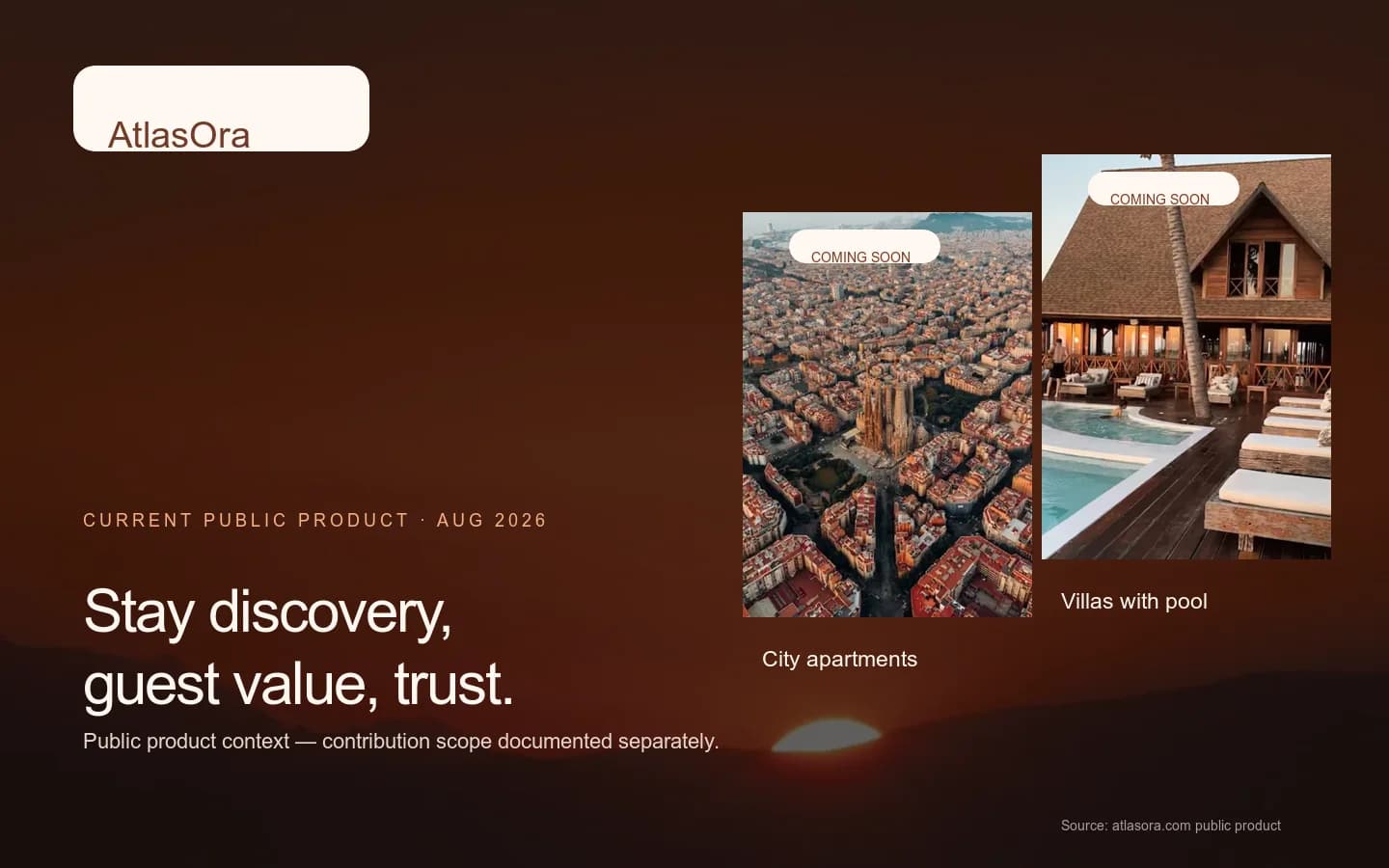
Stay discoveryVerified-host contextGuest value
Overview
A Web2/Web3 vacation-rental platform focused on trust, search, and smoother guest/host interactions.
A vacation-rental platform combining Web2 product functionality with Web3-oriented features, focused on trusted listings, user verification, search experience, and smoother guest/host interactions.
Problem, context, and constraints
Vacation-rental platforms need trust, usability, and strong identity verification.
Users need to search properties easily, while the platform needs reliable KYC flows and secure user onboarding.
Trust is critical in short-term rentals.
- KYC improves platform trust but adds onboarding friction.
- Sensitive identity data needs careful handling.
- Search needs to balance speed, relevance, simplicity, and maintainability.
- Web3 functionality needed to create product value without forcing unnecessary crypto friction.
My role and contribution
Full-Stack Developer
- Implemented KYC and user verification flows.
- Improved search behavior and user-facing search flows.
- Contributed to Web2 service integrations.
- Contributed to Web3-related integration points.
- Built full-stack features across frontend and backend surfaces.
- Improved user experience and platform reliability.
Architecture and system details
AtlasOra is a marketplace-style vacation-rental platform with guest-facing property discovery, host-side functionality, identity verification, and integration layers. Alejandro's work focused on improving trust and usability through KYC, better search behavior, and Web2/Web3 integration points.
01Frontend
- User-facing marketplace flows
- Search experience improvements
- Guest and host interactions
02Backend
- Backend logic for KYC
- Search and integration support
- Platform feature development
03Verification
- KYC provider integration
- User verification flows
- Sensitive onboarding boundaries
04Integrations
- Web2 service integrations
- Web3-related integrations
- Marketplace trust and usability work
Key technical decisions
- Context
- Vacation-rental marketplaces depend on trust between guests, hosts, and platform operators.
- Choice
- Implement user verification flows through KYC integration.
- Tradeoff
- KYC improves platform trust and compliance but introduces onboarding friction and requires careful handling of sensitive user identity data.
- Context
- Guests expect fast and relevant property discovery.
- Choice
- Improve search behavior and user-facing search flows.
- Tradeoff
- Search needs to balance speed, relevance, simplicity, and maintainability as listings grow.
- Context
- AtlasOra includes Web3-oriented functionality but still needs to feel smooth for mainstream users.
- Choice
- Contribute to Web2 and Web3 integration points without making the user experience unnecessarily complex.
- Tradeoff
- Web3 functionality should create product value without forcing non-crypto users through unnecessary friction.
Security, scaling, and reliability
- KYC flows require careful handling of sensitive user identity data.
- Search functionality must remain fast and relevant as listings grow.
- Web3 features should not make the user experience harder for non-crypto users.
- Integration code should be isolated and maintainable to reduce vendor lock-in.
- User onboarding and verification should be resilient to third-party provider failures.
Testing strategy
- Testing strategy focuses on KYC and onboarding flows, search behavior, API integrations, user-facing regressions, and provider failure boundaries.
- Exact test tooling and coverage are not public.
Result and proof
- Contributed to platform trust through KYC implementation.
- Improved product usability through search enhancements.
- Supported Web2/Web3 platform evolution.
- Served AtlasOra guests, hosts, and internal platform users.
Before
The platform required stronger verification, search, and integration capabilities.
After
Improved KYC/user verification flow, enhanced search experience, and additional Web2/Web3 functionality.
Challenges, tradeoffs, and next steps
Hardest part: Balancing trust, compliance, and usability. KYC adds friction, but it is essential for marketplace trust. Search also requires careful product thinking because users expect fast, relevant results without complexity.
Key learning: Practical experience building marketplace features, integrating external services, and connecting Web2 product flows with Web3-related functionality.
- Improve documentation around integration boundaries.
- Add clearer architecture diagrams.
- Strengthen automated testing around KYC/search flows.
- Define measurable search-quality metrics.
- Add more explicit observability around third-party integrations.